I wrote a new U.S. Constitution using Claude AI
What if you could start over with government? Not fix a broken piece here or there — but actually design it from scratch, knowing everything we know about how power gets abused?
That's what I spent a few hours doing with Claude, Anthropic's AI assistant. What came out the other end surprised me.
It started with a simple question
The U.S. Senate was designed in 1787 to protect wealthy landowners. Senators serve six-year terms specifically so they stay insulated from what regular people want. The Founders literally called popular opinion "temporary passions" that needed to be slowed down.
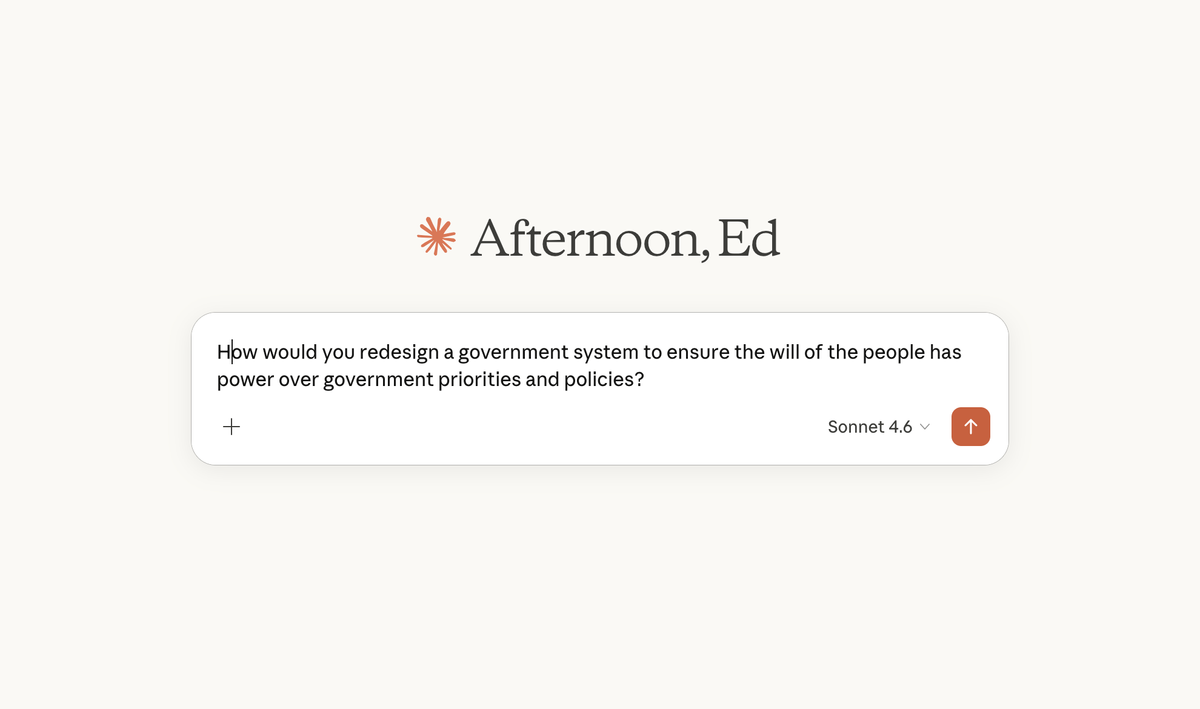
So I asked Claude:
if we were building government today, from scratch, with the goal of making it actually respond to regular people — what would that look like?
We spent a few hours going back and forth, adding pieces, stress-testing them, finding the holes, and fixing them. We looked at the 2009 Bolivian Constitution, which is one of the most people-centered governing documents ever actually ratified by a real country. We asked hard questions. We changed our minds several times.
Here's what we built.
Five branches instead of three
The U.S. has three branches of government: Congress makes laws, the President carries them out, and the courts decide if laws are legal. That's it.
The problem is that all three can be captured by money and power over time — and there's no independent body making sure elections themselves are fair.
Our design has five branches of government.
1: The Popular Assembly
The first is the Popular Assembly — this is like the House of Representatives, but elected differently. Instead of winner-take-all districts where one party shuts out everyone else, each area elects four representatives. Voters rank their choices. This means a Green candidate in a conservative area, or a libertarian in a progressive one, can actually win a seat. Third parties become real and engaged. To get on the ballot you need 500 signatures from neighbors — not money. Every candidate gets the same public campaign budget. Private donations are banned entirely.
2: The Citizen Senate
The second is the Citizen Senate — This one is the most unusual idea in the whole design. Instead of electing senators, you pick them the same way we pick juries. Random citizens, chosen by lottery, serve for one year. They can't be lobbied into a second term that doesn't exist. They don't have donors. They don't have a political career to protect. They just show up, learn the issues, deliberate like a jury, and vote their conscience. Due to the impacts mass media and disinformation campaigns have had in making facts hard to access, a set of minimum qualifications and a selection process need to be developed for Citizen Senate candidates.
3: The Executive Council
The third is the Executive Council — This is similar to a President and cabinet, but with one enormous difference. They have no veto. They cannot block a law they disagree with. Their only job is to carry out what the Legislature decides. If they refuse, there's an automatic escalation process that ends with citizens voting to remove them — no waiting for Congress to act.
4: The Constitutional Court
The fourth is the Constitutional Court — This is similar to the Supreme Court, but judges are appointed through a three-way lottery and supermajority system. The President appoints nobody. This closes the biggest loophole in the current U.S. system, where one president can reshape the court for a generation. Article 35 of the draft constitution specifies nine-year non-renewable terms for judges on the Constitutional Court, staggered so three expire every three years. Non-renewable is the key word: a judge serves once and is done. No angling for reappointment, no loyalty to whoever might extend their tenure.
5: The Electoral Branch
The fifth is the Electoral Branch — This is a completely independent body that runs all elections, enforces campaign finance rules, and manages the citizen lottery. Its budget is fixed by the Constitution itself, so no Congress can starve it into compliance. It answers to no one.
The floor that nobody can touch
The 2009 Bolivian Constitution teaches us something important: some rights need to be completely off the table, permanently, no matter who's in power.
We called this the constitutional floor. It includes water, food, health care, education, and housing. No law can take these away. No emergency can suspend them. No referendum can vote them out. Not even a supermajority. They exist because a person who is sick, hungry, or homeless is not truly free — and a government that can remove these things has ultimate power over the people it's supposed to serve.
The law must justify itself
This was the idea I found most interesting. Right now, laws accumulate forever. It's easy to pass a new law and nearly impossible to repeal an old one. The statute books in most countries contain thousands of laws that nobody has looked at in decades.
Our design flips this. Every law has to pass a four-part test before it can even come to a vote:
First, is there a real harm to other people — not just something someone finds annoying or morally wrong, but an actual documented harm?
Second, is a law really necessary, or could the problem be solved some other way without restricting anyone's freedom?
Third, is the law limited to exactly what the harm requires — no broader?
Fourth, does the law expire in ten years unless actively renewed?
This last part is important. Laws don't last forever by default. If a law is still needed after ten years, legislators have to make the case for it again, from scratch using current evidence. If nobody bothers, it disappears. This keeps the law books from getting buried under decades of accumulated rules nobody remembers passing.
What happens when the government won't do its job
This is something most constitutions completely ignore: what if the government just... refuses? Not breaking a law. Just doing nothing.
We designed a step-by-step escalation system. If the Executive Council hasn't started implementing a law after 30 days, a public declaration goes out naming them and the law. After 60 days, an independent commissioner takes direct control of the budget for that law. After 90 days, Executive Council members who failed to act personally lose the right to hold any public office. After 120 days, a citizen recall referendum kicks off automatically — no Congress needed, no political negotiation. The citizens decide directly.
Every step happens on a calendar. Nobody has to decide to start it. It just runs.
The Bolivia lesson
Bolivia actually ratified a constitution like this in 2009. It had many of these same ideas — direct democracy, indigenous rights, strong floor rights, popular control over natural resources.
It also showed us what can go wrong. President Evo Morales, who championed that constitution, later tried to bypass its term limits. He used courts he'd influenced to rule in his favor. He tried to run referenda through an electoral body that wasn't truly independent.
Our design tries to close each of those doors. First ALL positions in government are filled by citizens with limited terms. Judges are selected by lottery, not presidential appointment. The Electoral Branch controls its own budget with no private funding allowed. Changing the constitution requires two supermajorities plus a citizen referendum — all three at once. No single popular leader, no matter how genuinely beloved, can rewrite the rules during their own term.
What this actually is
To be clear: this is a thought experiment, not a political platform.
The goal is to spark a movement that encourages citizens to craft a new and more democratic system of government that finally fulfills the promises we know now as “The American Dream.”
Claude and I were designing such a system, the same way you might design a better school or a better hospital, asking what it would look like if our government actually worked for everyone.
The full document we produced is 57 articles across eight sections. It draws on notable political philosophy, real constitutional law from Bolivia and other countries, and a lot of back-and-forth about what fails and why.
Is it perfect? No. We found weaknesses in almost every piece we designed and documented them honestly. The citizen lottery Senate has real vulnerabilities around competence and legitimacy that need to be addressed. The necessity test could be gamed by a determined majority. The communal governance provisions need ongoing real-world deliberation with indigenous communities to be meaningful.
But here's what the exercise showed me: the problems with modern democracy are not mysteries. We know why money dominates our politics – to maintain the status quo. We know why representatives stop listening between elections. We know why courts get captured and executives overstay their welcome. The solutions aren't mysteries either — they've been thought through by political philosophers, constitutional scholars, and ordinary citizens for centuries.
What’s new is the realization in this moment we can do something different. Together we can change the system. The question is... will we?
We are deeply conditioned to surrender our personal power to all kinds of “authorities” including: laws, governments, officials, executives, experts, gurus, and even social media influencers.
And we are used to always asking “How?” whenever we are faced with doing something new and challenging.
Protesting against something won't cut it. Whatever you are protesting against is already happening.
We must create our own plans and take action only in support of things that we want... not against things we don’t want.
I hope this new U.S. Constitution is the seed of the change we want.
Download and read the full constitutional draft below.
Want to see the full AI conversation that built it? Read the complete Claude chat here.
Drop a comment below with your thoughts.